Dion Chang discusses travel
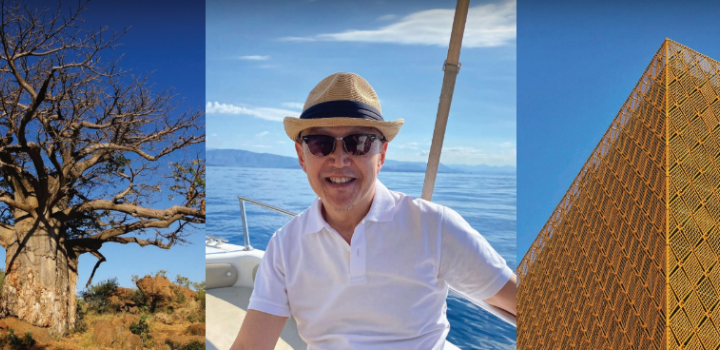
The futurist, creative thinker and seasoned adventurer discusses travel trends, finding joy in business trips again and how he optimises all that time spent in the air
Dion Chang, who has 20 years of media experience and a deep passion for trends and subcultures, has been travelling since he was a boy.
"Days before my 12th birthday, my mom took me on a month-long trip to Europe, and didn't want to leave me alone in a hotel room in Paris, so she smuggled me into the Lido. This sparked my wanderlust." It's perhaps because of this early introduction to the world and its wonders that Dion now helps others see it with fresh eyes. The strategist, keynote speaker, walking ideas bank and professional cage-rattler is also one of South Africa's most respected trend analysts - that is why he founded Flux Trends (which sources unexpected business opportunities, often from disruptive technologies). We got hold of him just before he flew off for a holiday in Corfu.
Is revenge travel (vacationing post-lockdown) still a thing?
We saw revenge travel happening in the northern hemisphere from June. Borders eased and everyone wanted to adventure again, and my social feeds looked like the travel channel. But revenge travel quickly became chaos travel. We saw a lot of people who were happy to be out again but were so rude. It's become so bad that cabin crew in the US are being given selfdefence lessons. For us in the southern hemisphere, it will be a lot better because the systems have had time to correct themselves and we're fortunate that some of those problems will abate. Still, learn a bit of reentry etiquette because you need to get used to being with a lot of people, especially when trapped in a metal cigar in the sky.
Where did you go as soon as borders opened again?
I live to travel, and those two years of confinement were the hardest time of my life: from being away every week to sitting in the same chair and staring at the same wall for two years... My first trip was to Riyadh in Saudi Arabia, to lecture a masterclass in innovation. Otherwise, there was a lot of commuting locally and then also places in southern Africa like Namibia and Botswana. I'm actually leaving for Corfu tomorrow. Friends got in touch saying that they'd rented a villa and we just needed to get ourselves there. It would've been rude not to go. Corfu will be my third holiday for the year. I recently did a road trip to Plett with friends from London, and took my mom to see the Namaqualand flowers.
"The pandemic reignited my love for travel. I love discovering liminal spaces i love transient spaces. I love hotels. I love being in different cities. I just don't like flying"
How do you make business travel better?
- Well, the pandemic reignited my love for travel. I love discovering liminal spaces. I love transient spaces. I love hotels. I love being in different cities. I just don't like flying. So, I figured out how to remove the pain points, which I do in a few ways:
- I check in the second the online booking opens because I want to be as far in the front or back as possible - to get on and off the plane as quickly as possible.
- Airport lounges are non-negotiable and worth every cent.
- I've also learnt that because people travel with so much luggage there's often no space in the cabin. Priority boarding gets me onto the plane first and ensures that there's space for my carry-on.
- Travel is easier now without the masks, but I'll still wear one. Especially when I know I'll be on one of those little planes that are too small for an airbridge. If I'm squashed on a bus, out comes the mask. I can't afford to get the flu.
- Because of people losing baggage, if you can travel with hand luggage only, do it. However, if you need to check in your luggage, use a tracking device such as an Apple AirTag. For connecting flights, choose a long connection because those quick connections can be dicey.
- Lastly, be nice. Especially when experiencing chaos travel.
How do you spend your time up in the air?
I always have a stack of the Financial Times Weekend Magazine and art pages, as well as a few weeks' worth of whatever I haven't got around toreading yet. The time between getting to my seat and take-off is devoted to paper reading - meaning reading from printed paper, books and magazines. It maps the brain differently, because online isn't serendipitous. You're always looking for something. Whereas analogue reading - especially the FT, which has the best writers and columnists in the world - allows you to stumble upon knowledge.