True Colours by Shaazia Ebrahim
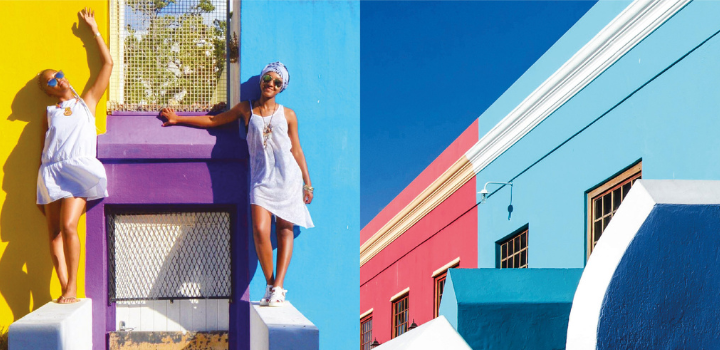
Shaazia Ebrahim speaks to South Africa's leading influencers and discovers that Bo-Kaap is a living story of an eclectic community in the heart of Cape Town.
At the foot of Signal Hill, a stone's throw from the CBD, is one of the most Instagram-worthy Cape Town spots: Bo-Kaap.
A trip to the Mother City is incomplete without a stop at the Smarties-coloured huurhuisjes (rental houses) that the Dutch colonists leased to the Cape Malay slaves as early as the 1760s. Built in Cape Dutch and Georgian architectural styles, the houses had to be white while on lease. When this rule was finally binned and the community was allowed to buy the properties, they painted the houses in bright colours in celebration of their freedom.
Most importantly, Bo-Kaap is home to the Cape Malay community, whose fusion culture is made up from the lived experiences of slaves brought from Malaysia, Indonesia and other parts of Asia and Africa to work in the Cape. Many families who live in Bo-Kaap have lived there for generations, and the community is a fundamental part of the Cape's cultural heritage. We spoke to content creators about their top tips to help you get the most out of your visit.
African travel blogger Farirai Sanyika (known as Gophari) counts Bo-Kaap among her fave cultural hotspots in SA. "Colours bring joy; Bo-Kaap is a happy place. It's a showcase of the Cape Malay community's heritage. I love that visitors are welcomed warmly and that it is free to go there. There's no place like Bo-Kaap in South Africa. Beyond it being incredibly 'Instagrammable', it is a destination of historical significance for its community,"" Farirai says.
"There's so much to learn about this oldest surviving residential neighbourhood in Cape Town," says travel content creator Tebogo Pin-Pin. "Learning about the area you plan to visit and its community gives you a better understanding of the environment and how it should be treated."
Comedian Yaaseen Barnes has family in Bo-Kaap, and says the community is close to his heart. He encourages visitors to look beyond the postcards. "Bo-Kaap has such a warm community. You speak to someone, greet them and they will welcome you into their home. They will tell you stories for days about every generation that has lived there and everything they went through to still be there. It's a tourist destination that brings you to the people of Cape Town," he says. "When speaking to the locals, we call older men 'Uncle' and older women 'Aunty' as a sign of respect."
Bo-Kaap is part of the lineage of Islam in SA, with the first established mosque in South Africa: the Auwal Masjid, built in 1794. Here, you can learn about the story of Tuan Guru, its first Imam (priest). There are many mosques in the Bo-Kaap, and all of them are well-loved with their own place in history. Hearing the athaan (call to prayer) in Bo-Kaap is a special part of the experience. "It makes you feel part of the community. You hear it and think, I'm close to home and I'm close to people, I'm not just an outsider," Yaaseen says.
He encourages visitors to eat in Bo-Kaap because food is part of the culture. There's Bo-Kaap Kombuis, offering traditional Malay food, which has survived over generations. There's also Biesmiellah, a fast-food venue, which serves the street food of the community and Cape Town. Against The Grain, Barnes' friend's café offering coffee and Cape Malay fusion cuisine, puts a fresh twist on local food.
Food and lifestyle blogger Razeena Palekar also encourages visitors to sink their teeth into the most delicious koeksisters (spiced Cape Malay doughnuts drenched in sticky syrup and rolled in coconut) in the city. She swears by the koeksisters served at Rose Café.
The best time to visit and shoot content? The off-peak hours. "Given the location of Bo-Kaap near the inner city, it's best to avoid visiting during peak times," Razeena advises. Tebogo adds to avoid the main street (Wale) because it's so busy. "Park there, but take a walk to inner small streets to get the best pictures. They are always quieter," he says.
Razeena's top outfit tips for Instagram-worthy content? First, choose comfy shoes because the incline isn't for the faint-hearted. "Try to stick to neutrals and simple colours when planning your look so you stand out better against your generously bright backdrop!" Razeena says. Bear in mind, though, the houses around Bo-Kaap are homes. "If you see people sitting outside, greet them and ask if it's okay to take pictures," Tebogo encourages.
Echoing Tebogo, Farirai says, "Though visiting Bo-Kaap comes at no cost, consider giving to the community by taking a paid guided tour or a Bo-Kaap experience like a Cape Malay cooking class. You can find local-run activities through Airbnb Experiences," she says.
Follow Yaaseen's advice and connect to the space. "The photos you take will look and feel different because you are different. When you know about Bo-Kaap and you have a relationship with it, you'll take pictures that are unique," he says.