Thanks to Personal Health Pathways Brink (45) went for a routine colonoscopy and picked up stage 3 colorectal cancer before it progressed
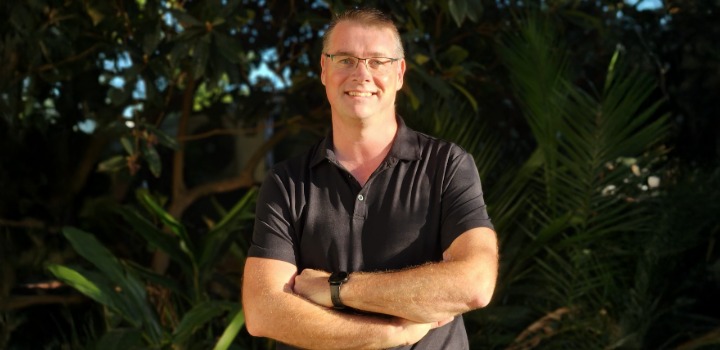
Just a few months ago, Brink le Roux's Personal Health Pathway recommended that he get a routine colonoscopy. If it wasn't for that, he may have put off getting some troubling health symptoms he was experiencing checked out.
Watch Brink's video below to see him ringing the bell at his oncology centre, marking the end of the first round of his treatment.
Brink put his health on the back burner and focused on his work and family
Earlier in the year, Brink - a Discovery Health Medical Scheme member - activated Personal Health Pathways when he saw the display tile on the Discovery Health app.
"My Personal Health Pathway was very easy to set up, understand and use," he says. Some of his first recommended health actions were to complete a prostate cancer screening and have his cholesterol levels checked - through his GP.
Then in August, Brink (who lives in the Western Cape) started to feel unwell, which he thought was mostly because of poor eating. "I had been travelling quite a bit and eating lots of takeaways."
Then Brink received an email from Discovery Health Medical Scheme encouraging him to engage with his Personal Health Pathway. His next health action was to ask his doctor about bowel cancer screening, to better understand the tests available and which was most suitable for Brink (for more information on colorectal cancer screening and Discovery Health Medical Scheme cover, refer to the end of this feature).
Brink scheduled an appointment with a doctor to chat through his symptoms. The doctor agreed that something wasn't quite right and it warranted a check. "I scheduled the colonoscopy for the following Wednesday. It was the first one I'd ever had."
When Brink woke up from the anaesthetic the doctor was already at his bedside
The doctor told Brink that during the procedure, he had discovered a mass and taken a sample for biopsy. By Friday morning, the doctor phoned Brink and asked that he and his wife come through to his consulting rooms to discuss the results. Brink immediately asked if it was cancer. "He said, 'Yes, it's cancer'."
Brink then went to see a recommended oncologist, where it was confirmed that he has stage three colorectal cancer because it had spread to nearby lymph nodes. They discussed different treatment options and Brink decided on an aggressive approach - two rounds of a combination of radiation therapy and chemotherapy pills.
"I started treatment on 22 October. I had to go to the oncology centre for radiation every day for six weeks."
Dealing with side effects through round one of treatment
Brink experienced nausea, hand-foot syndrome (a common side effect of chemotherapy treatment that causes redness, numbness or pain, swelling and even skin peeling on the palms and soles of the feet), and fatigue. "When I got back from radiation, I would take my chemo pill, sit upright for three hours and then sleep for six hours," he says. He also experienced some burning on his left thigh from the radiation treatment, as well as some inflammation of his bowels and kidneys.
Brink is scheduled for another round of chemotherapy treatment (a combination of intravenous drip and pills) on 22 December 2025. "We're doing another 18-week round of treatment - so we can make sure that we get every portion of it," he says.
Brink feels motivated to make the most of using his Personal Health Pathway
Brink admits that he wasn't all that physically active prior to his cancer diagnosis. "I think this cancer scare is big enough to get a guy like me into the mindset of starting to exercise and look after my diet far more too," he says.
"When we started the first round of treatment, the doctor told me to walk three kilometres a day, at least. So, I started doing this during the six weeks of treatment," he says. "I'm still walking every day to keep up that new routine.".
Brink has only recently linked his smart watch to his Vitality profile and is keen, in future, to start meeting his Personal Health Pathway weekly exercise goal of accumulated daily steps to earn Vitality instant rewards and Discovery Miles.
Through this journey, Brink has continued to keep an eye on his recommended health actions on the Discovery Health app and complete as many as he can, earning funds in his Personal Health Fund along the way, which he's used to pay for over-the-counter medicines needed through his treatment. He loved the fact that he could pay for these with funds he'd accumulated for engaging in healthy behaviour.
Brink is grateful his Personal Health Pathway led him to discover his cancer when it did
Brink now clearly sees the preventive benefits of Personal Health Pathways. "Any of the health checks Personal Health Pathways recommends can potentially pick up something concerning in time to act. It gives that power back to you to do something about it," he shares.
- Discovery Health Medical Scheme members are covered for a bowel cancer screening tests every two years (for members between 45 and 75 years old). Find out more.
What is Personal Health Pathways?
Personal Health Pathways is a free tool available to adult DHMS members via the Discovery Health app. It provides personalised, real-time health recommendations based on each member's unique profile. As a member's health journey evolves, so does their pathway, continuously updating based on their specific health status, risk profile and engagement patterns and dynamically adjusting as new health data become available..
Personal Health Pathways combines artificial intelligence, predictive analytics and behavioural science. The platform uses more than 50 million life years of health claims and clinical data, along with nearly 30 million life years of exercise and lifestyle data gathered through Vitality in South Africa, to recommend actions that have the greatest potential to improve health outcomes.
Members earn rewards for engaging, including shopping vouchers, Ðiscovery Miles and instant rewards. Those Scheme members who are also Vitality members earn personalised rewards through Personal Health Pathways in addition to their Vitality rewards.
Then, each Personal Health Pathways cycle provides up to two clinical actions and one weekly exercise goal, which must be completed by a set date. Members can earn up to R500 into a new Personal Health Fund for each completed action, up to a maximum of R10,000. The money that is accumulated in the Personal Health Fund can be used for day-to-day medical expenses, including GP and specialist consultations, medicine, radiology and pathology.
Find out more about Discovery Health Medical Scheme cover for colorectal cancer screening
Discovery Health Medical Scheme members aged 45 to 75 who are of average risk for colorectal cancer have cover for stool screening (faecal occult blood screening) once every two years.
Members who receive a positive faecal occult blood test result are considered at high risk for colorectal cancer are eligible for a colonoscopy - without a copayment when the procedure is performed in a doctor's rooms or within the Scheme's designated scope network. The costs charged by healthcare professionals will be covered either partially or in full, depending on whether the member uses a provider within the Scheme's network.
Members are considered at high risk of colorectal cancer if they have a personal history or a first degree family history of colorectal cancer or advanced adenoma diagnosed before age 60, or if they have a polyposis syndrome such as adenomatous polyposis, familial adenomatous polyposis, or sessile serrated adenomatous polyposis.
High risk status also includes those with hereditary non polyposis colorectal cancer, Peutz Jegher syndrome, or anyone who has received a positive bowel stool screening test.
Find out more by reading the 2025 Screening and Prevention brochure.